
Troyan Monastery and its surroundings

Mountains of the Troyan region (Bulgaria)
Not an opinion, it is a fact that the mountain of the Central Balkan Range surrounding the Troyan Monastery is one of the most beautiful parts of the entire range, And it has also been designated by the Ministry of the Environment of Bulgaria as the one that enjoys the purest air in the whole country. The slopes are covered by dense forests, rivers of crystalline waters flow through valleys and small villages and a narrow road rises and rises until reaching the port of Beklemeto at 1.595 altitude meters, where a monument called “The Arch of Liberty” will welcome us to the port.
Not only nature makes this place something special. The inhabitants of the Troyan region distill a characteristic and tasty variety of the typical Bulgarian alcoholic drink, the “rakia”, which is produced here using plums instead of grapes. Local pottery, that in this region uses bright colors, It is also a distinctive sign of the area and is even used as a symbol of the country, as a souvenir or also used daily in traditional style restaurants around the country…

Hotel in Chiflik
Very close to the monastery is also the town of Chiflik, well known among Bulgarians as a seaside resort, where several hotels offer outdoor pools with natural thermal water that remains warm even in winter. These hotels in Chiflik provide various treatments in their Spas using natural hot springs from the spring in the area and are located in the mountains, surrounded by thick forests. A few days in this region enjoying the walks and fresh air of the forests, and the thermal waters have an immediate revitalizing and rejuvenating effect. In addition, the opportunity to try grilled trout should not be missed., typical dish of these mountain areas that have numerous rivers with clear waters.
But Troyan is also a place for art and spirituality, taking shape in the impressive Troyan Monastery, the third largest in the country after Bachkovo and Rila. The one with Troyan, unlike these other two older ones, it has no medieval origin. The Troyan Monastery which officially has the name of the Monastery of the Assumption of Mary” was founded around the year 1.600 in the river valley “Cherni Osam” by a monk who came from the monastic community of Mount Athos, area that is currently Greece but centuries ago was the territory of Bulgaria. For its part, the Troyan Monastery is currently located in the municipality of Oreshak, Troyan region.
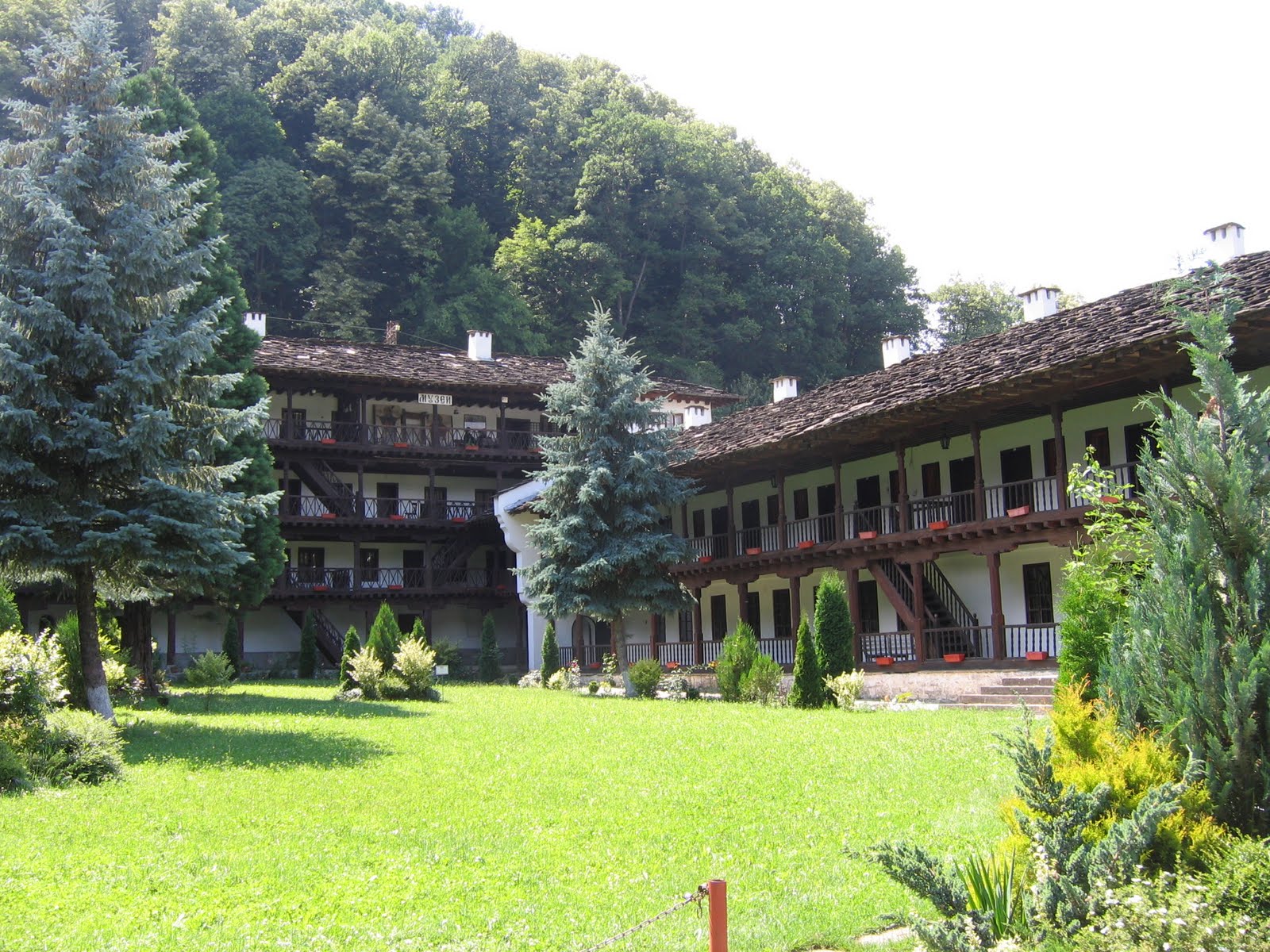
Orthodox monastery of Troyan

Interior of the Church with miraculous image on the left
Soon pilgrims and other monks began to gather in Troyan, attracted by the supposedly miraculous image of the Virgin Mary brought from Mount Athos and still preserved in the Monastery, It is very adored and queues always form to kiss the image, venerate her and of course ask her wishes…The image has 3 characteristics silver hands on it that make it different from other images. Tradition says that the image was bought here in Troyan from a monk who transported it from Mount Athos to the Wallachian region, South of Romania. Said monk stopped at the then small Monastery of Troyan, spent time there and when he tried to resume the trip, according to the tradition, the picture “did not let him” leave the monastery.
Finally the monk understood the message sent by the icon and left it in the Troyan Monastery, he continued the journey to Wallachia…

Entrance to the Church inside one of the courtyards
Although the Monastery was attacked at least once by the Ottoman armies, held up well and reached great size and prosperity by the middle of the century 18, and in fact it was used as a primary school to revive traditional Bulgarian education and culture, overshadowed for centuries by the oppression of the Ottoman invasion. The monastery was restored at the end of the century 18 and the result is what we see today with buildings for the cells of the monks around 2 courtyards, with the church inside one of them. The two patios that the Monastery has are spectacular, wood predominates in its construction and the roofs are covered by huge plates of natural stone, in the style of traditional Bulgarian houses, but here the largest slabs that can be seen in the country were used, placed without plasters or any type of anchoring, just some supported on others…The large number of cells for monks gives us an idea of the great activity that the Troyan Monastery must have had during its period of splendor.

Frescoes outside the Church

Balcony in one of the patios of the Monastery

Fresco “moralistic” inside the Church
The stone church in the main courtyard was built in 1.835, on a previous one that was from 1.780. The frescoes with which the interior is decorated are one of the reasons why the Monastery is recognized as a jewel of Art. To understand this, you have to know that Bulgarian art had not progressed since medieval times, centuries under Ottoman rule and the isolation of Western Europe had been the reason why Bulgarian artists only painted religious motifs, keeping the strict rules of ancient Byzantine art. In the first half of the century 19, everything changed and the influences of Baroque and Rococo began to enter, being the artist Zahariy Zograf (1810-1853), the one who first incorporated these styles into Bulgarian art, An example of this are the frescoes of the Troyan Monastery, which do not show medieval Byzantine saints but Bulgarian saints of the Old and New Testaments. In addition to these saints we can also find a curious fresco that represents “The wheel of life”, an allegory about the course of human life, with the hopes of youth, the ambition and confidence of maturity, the sorrows of old age on an endless wheel… where even today each visitor can find their place within the “wheel of life” and meditate on the purpose of human life, its fragility and many other ideas that come to mind when contemplating this fresco. Zahariy Zograf gives his own answers in his frescoes like the attached image in which he implies that if you receive alternative medicine from clairvoyants or healers you are literally receiving “devil shit”. By the way Zahariy Zograf painted himself on the North wall of the Church, in what is the first self-portrait of Bulgarian art, a daring for those times of strict standards in Art.
In addition to its religious and spiritual value, Troyan Monastery is also of great importance in the History of Bulgaria. In this monastery the national hero Vasil Levsky created a revolutionary council against the Ottoman occupation, the rebel council met secretly from the Ottoman soldiers inside the Monastery, secretly protected by the monks of the Monastery. In fact, a small cubicle is preserved where Vasil Levsky used to hide when the Ottoman soldiers appeared in the Monastery looking for him..
But don't let me tell you everything, there are many corners and stories that you can discover yourself if you visit it in person and we can help you, contact us and we will help you with hotel reservations, rental car, even with a guide to help you with the language…
In addition, this monastery offers accommodation (like others in Bulgaria, see article: Accommodation in monasteries in Bulgaria), and just a few months ago a wing of the monastery with newly renovated rooms for those interested.
Latest Articles

Bulgaria: Origin of the Goths and other ancient civilizations.
6 from October 2022
The Goths are considered as a people of Germanic origin but it is time to establish that the origin of the Goths is in the Balkans..

Why do Tourism in Bulgaria?
7 September, 2022
Thinking of sightseeing in Bulgaria? ️ What you should know: some peculiarities of the country that the travel guides do not tell you.

Rila monastery
17 Abil, 2022
Rila Monastery in Bulgaria: Location, his story, hiking trails in the surroundings, schedules and more.

What to see in Bulgaria in 12 days ?
12 from December 2021
The best travel route to visit Bulgaria in 12 days: the best cities, typical towns, monasteries, the Black Sea Coast.

Sandanski City.
17 of May 2021
How to get. Where to stay. To do. Places of interest. Hotels-spa. Swimming pools. Excursions to Pirin mountain. And more...

City of Veliko Tarnovo
27 of March 2021
Veliko Tarnovo, a fascinating city whose visit must be planned in advance. Read our proposal of where it is better to stay and how to get there by car

Viajes fly and drive , What should you know?
26 February 2021
Advantages and disadvantages of fly and drive or self-guided trips and details that nobody tells you but you should know before traveling

Bike tour organized by Bulgaria
16 February 2021
An entire MTB adventure for you and your friends on this organized bike trip with a local guide through the mountains of Bulgaria
Send a reply