
Hillock, the cave with the oldest cave paintings in Europe
Magura Cave in Bulgaria.
Summary of contents of this page:
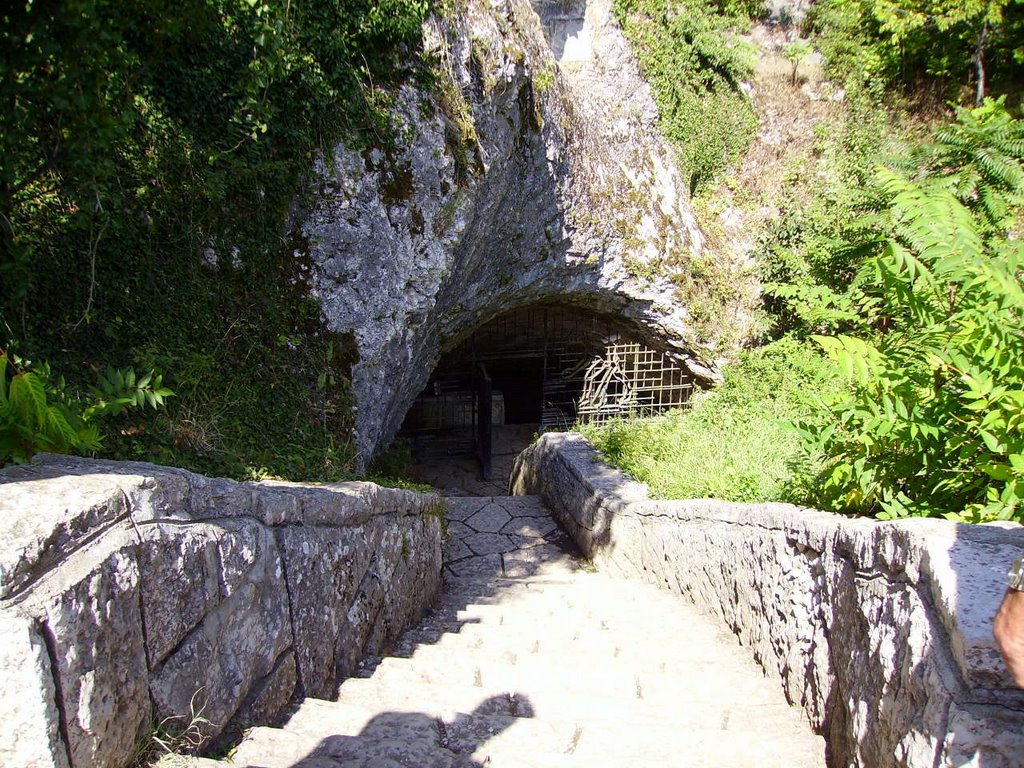
Entrance to the Cave of Magura
Cave location.
Magura cave is located in northwestern Bulgaria, a 17 km de Belogradchik, in the limestone mound "Rabishka Moguila" (461 meters above sea level). It is one of the largest and most beautiful caves in Europe. Its part that can be visited, open to the public, It is the largest in Eastern Europe after the famous Postojna and Škocjan caves in Slovenia . It consists of a main gallery and three lateral branches that add up to a total of about 3,6 kilometres. The main gallery is of 700 meters long. It was opened to the public in the year 1960, coincidentally the same year that our well-known Nerja Caves were opened.
Origin and characteristics of the Magura cave.
The origin of the Magura cave is estimated approximately 15 millions of years. The tectonic activity allowed the entry of water and favored the karst process of formation of the cave. Water activity has created fantastic formations like stalactites, stalagmites, pisolitas (cave pearls), moon milk, etc. Apart from the beauty of these formations, some of them stand out in large size, such as the “Large stalactite” of over 20 meters high (one of the largest stalactites in Europe) and 4 meters in diameter. There is also a huge fallen stalagmite, “the Fallen Pine” of over 11 meters in length and a diameter of 6 meters.

Like many other caves, offers a specific microclimate with a constant temperature of 12º C throughout the year. The absence of light provides ideal living conditions for those beings adapted to life in the depths., most invertebrates, but also by a multitude of bats, up to 5 different species that populate this cave. The fossils found show that in ancient times the cave was used by cave bear (almost twice the size of today) and also the cave hyena.
Oldest cave paintings in Europe.
But what also makes Magura cave special is the anthropological discoveries that have been made in this cave. In fact according to some researchers the presence of humans in the cave dates back to 42.000 years ago and therefore according to them their cave paintings are the oldest in Europe with those 42.000 years old and which are also the most important cave paintings in the entire Balkan Peninsula by state of conservation and complexity. This area of Bulgaria is also mentioned as the origin of the Aurignacian culture that later spread over the rest of Europe and where what can be classified as the world's first religion originated., even before paganism.
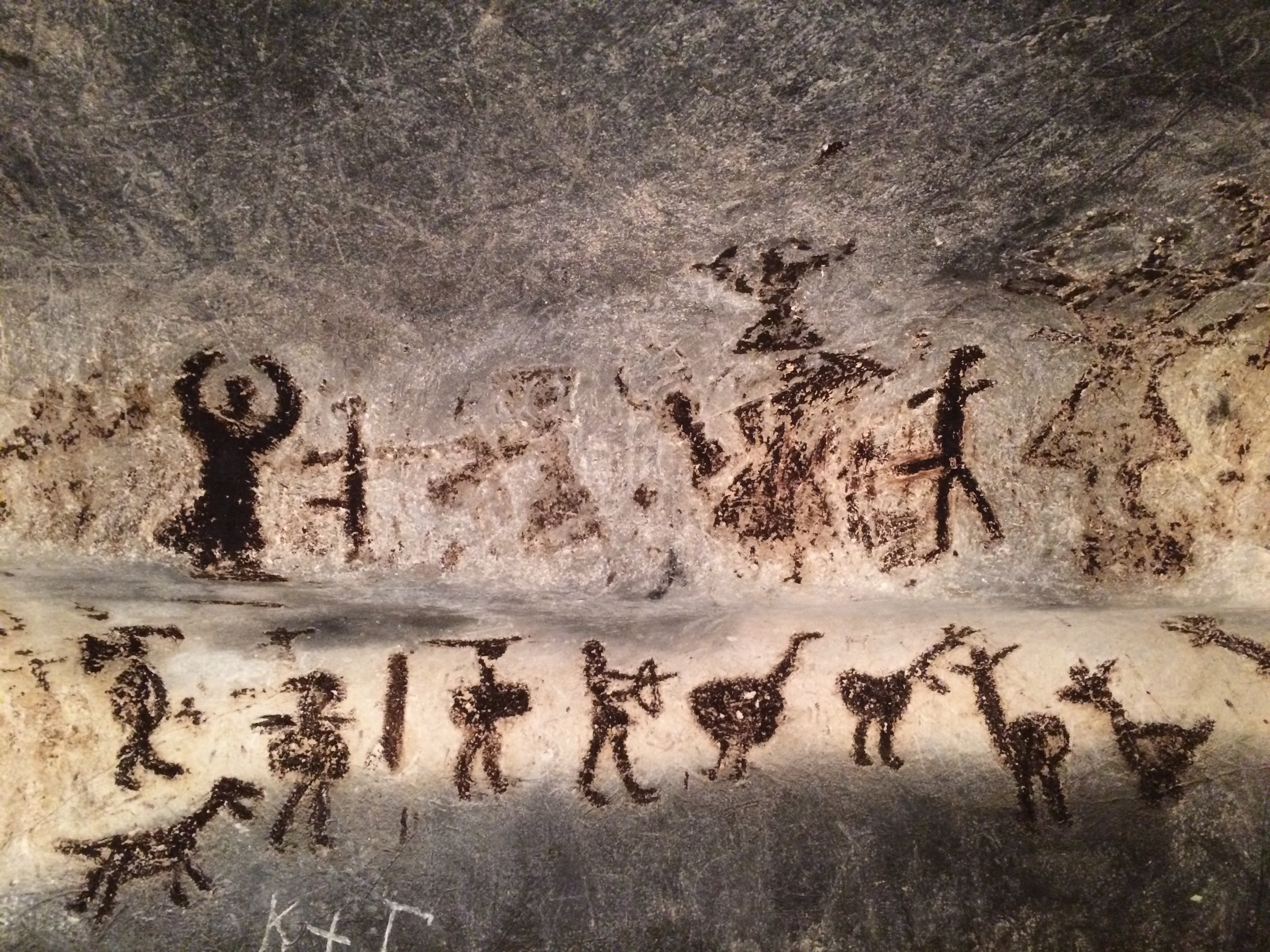
Cave paintings of more than 42.000 years of antiguaty (those of Altamira are dated in 35.000 years)
Cave paintings depict spirits and dancing women, men hunting, variety of animals, soles, stars, tools, plants,…and are decorated with bat guano (faeces). Figures represent silhouettes of spirits, women dancing, of men hunting and dancing, of disguised people, animals, stars, tools, plants. The drawings date from different eras: Epipaleolytic, Neolithic, Eneolithic and the beginning of the Bronze Age. Another noteworthy fact about Magura cave is the Late Neolithic solar calendar, which is the earliest solar calendar found so far in Europe. It is painted on the walls of the sanctuary room and marks at least five holidays., as well as a year of 366 days, quite accurate given its age.

Symbols of the Magura cave paintings representing people.
It is worth noting a characteristic symbol of these cave paintings that is the symbol of “Ankh” or what is now known as “Cruz Ansata” and that it is a very used sign in Egyptian iconography, However, this symbol has its first representation in Magura and is previous by several centuries to those known from Egypt, so it is thought that there was emigration of some populations from Bulgaria to Egypt and that they left their mark on Egyptian culture.. The image above shows the evolution of this symbol in different parts of the Magura cave and represents a woman with her arms raised, which in later times will represent the Mother Goddess.

Sparkling wine cellar inside the Cave of Magura
The cave is also used for the production of sparkling wines, that mature in natural conditions in one of its galleries, very similar to those used in the production of French champagne.
Visit to the Magura cave.
The descent to the first large room is very steep and is done by a staircase that seems to end in hell, haha, There a group of cavers or archaeologists have a defined area where they carry out their work.
The road has no loss, You just have to follow a railing that is very helpful because the humidity is high and the floor is extremely slippery, in fact we all slip on occasion, although without consequences.
It was getting colder and colder on the descent, we barely went from room to room with few stalactites and stalagmites …. bats galore, and of considerable size…

Cave paintings room
The first gallery on the left is closed to the public because it is where they keep the wines, in the second on the left is where the cave paintings are found, you have to go through a narrow pass that if you get lost you miss the best of the cave, which are the cave paintings and that gallery that is the most beautiful and the one with the most bats.. However, recently the walls near the paintings were vandalized and therefore access to that area has been closed to the general public..
Then the main gallery continues through huge rooms where the huge stalactites and stalagmites that we discussed earlier are found., as one of the largest stalactites in Europe “The Big Stalactite”.

Main room with the Great Stalactite
Finally, a short flight of stairs is climbed to the exit to the outside. There is a small shop there that sells the wines from the winery that the cave uses to preserve its wines.. From there you have to walk a few 15 minutes to the parking of the entrance to the cave where we left the car.
It is allowed to photograph and record inside the cave. Next to the cave is Lake Rabishko which is the largest inland lake in Bulgaria, whose depth reaches 35-40 meters. Entry costs 12 takes (some 6 € to change), In summer groups are formed every half hour but outside of the high season there is nothing to wait and you enter directly, so we did in October.
Latest Articles

Bulgaria: Origin of the Goths and other ancient civilizations.
6 from October 2022
The Goths are considered as a people of Germanic origin but it is time to establish that the origin of the Goths is in the Balkans..

Why do Tourism in Bulgaria?
7 September, 2022
Thinking of sightseeing in Bulgaria? ️ What you should know: some peculiarities of the country that the travel guides do not tell you.

Rila monastery
17 Abil, 2022
Rila Monastery in Bulgaria: Location, his story, hiking trails in the surroundings, schedules and more.

What to see in Bulgaria in 12 days ?
12 from December 2021
The best travel route to visit Bulgaria in 12 days: the best cities, typical towns, monasteries, the Black Sea Coast.

Sandanski City.
17 of May 2021
How to get. Where to stay. To do. Places of interest. Hotels-spa. Swimming pools. Excursions to Pirin mountain. And more...

City of Veliko Tarnovo
27 of March 2021
Veliko Tarnovo, a fascinating city whose visit must be planned in advance. Read our proposal of where it is better to stay and how to get there by car

Viajes fly and drive , What should you know?
26 February 2021
Advantages and disadvantages of fly and drive or self-guided trips and details that nobody tells you but you should know before traveling

Bike tour organized by Bulgaria
16 February 2021
An entire MTB adventure for you and your friends on this organized bike trip with a local guide through the mountains of Bulgaria
Send a reply