
Bulgaria and Korea, united by their worship of the mountains
In this article we are going to compare some of the deities of the most spectacular mountains in Korea., its shrines and the Taoist tradition, with the mountains of Bulgaria, Orthodox Christian monasteries and the origin of the Bulgarian Orthodox religion. So although distant from each other, and being very different countries culturally and religiously, we will check that Bulgaria and Korea have many similarities….

Relationship between Bulgaria and Korea
Both the Republic of Korea and Bulgaria have a long and illustrious history, both are also rich in a valuable heritage and cultural heritage. Bulgaria and Korea love their mountains – “that give peace, harmony and splendor”, but there is another reason for this attitude in Korea: its mythical origin is a story that arises from the mountain. Bulgarian legends, its mythology and its tales and legends are also rooted in the ancient Balkan mountain stories. So let's listen to the voices of distant days and follow the path of centuries past in the attempt to assemble this puzzle piece by piece..
Historically, mountains have had a strong impact on Korean life and culture. The cult of mountain deities in Korea is a part of the country's folk religion and reveals some notable aspects of traditional East Asian beliefs.. Korea's mountain spirit cult focuses primarily on a grandfather spirit, called “San-sin” The “San-shin”. There are also different cult practices that encourage lesser spirits, located in individual mountains, known as “yo-sansin” who are native female deities.

In ancient Bulgaria the attack on paganism by Christianity caused the main pagan deities to disappear. A large number of pagan beliefs of the Slavs and Protobulgarians (the last came from Central Asia) remained, although converted and adapted to the new situation of Christian predominance. The origin of these divinities was explained as cursed spirits from heaven because they rebelled against the superior god who created everything. These spirits fell in a variety of places – those who fell in the fields and forests were left as evil spirits; those who were in contact with humans often turned into kind spirits. Folklore also spoke of female forest nymphs and spirits of mountains and rivers..
There are many mountain ranges in Korea, but the main one is the one that begins in the mountains “Baekdu” The “Baekdu San” on the border between China and Korea, goes east and then turns south. It spans almost the entire length of the Korean peninsula and eventually ends near the southern tip of South Korea.. The length of the mountain range “Baekdu San” is estimated to be around 1450 km and is considered to be the backbone of Korea. There are several sacred mountains along this mountain range and Taoists, Buddhists and shamans can be found there even today practicing their ideas in temples and caves. Koreans have long believed that their strength and vigor come from this mountain range as if it were an energy channel..

Typical sanctuary in honor of the spirit of the mountains “Sanshin”
For his part, in Bulgaria the mountain Stara Planina (literally means “old mountain”) stretches across the entire country from the Bulgarian-Serbian border, then in an easterly direction it reaches the Black Sea coast. It is also known as the Balkan mountain range and is located in the heart of the country, dividing it into two almost equal parts – Northern Bulgaria and Southern Bulgaria. The mountain extends is 555 km in length. In ancient times, the Thracians and the Greeks called this mountain range “Hemus” (The “Haemus”), name from the king of Thrace “Haemus” appearing in greek mythology. The Slavs called it Matorni Gori ( “mother mountains”), and the Turks called it Kodjabalkan (“big strong mountains”), or the balkans. The Central Balkan mountain range that is as it is officially known today, gives the name to the Balkan Peninsula.
Stara Planina mountain plays an important role in Bulgarian history and traditional beliefs – in the Middle Ages it was a natural frontier and also a refuge for freedom fighters throughout the history of Bulgaria.
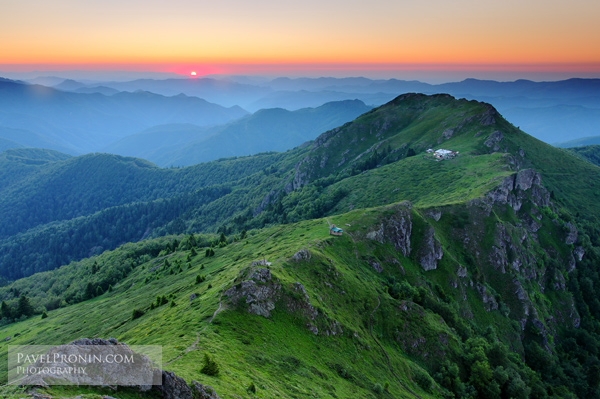
Central Balkan Mountain Range in bulgaria
There have always been a variety of spiritual practices in the mountains of Korea and most of the shamans are women.. They perform rituals during which they enter into a trance and contact with the spirit world. These rituals, The “Pussy”, are carried out in order to attract good fortune, abundant harvests, cure diseases and improve communication between spirits and humans. Shamanic rituals and practices have been performed in Korea for several thousand years; Taoism (the Daoism) in this country it is less known in ancient times. The first Korean Taoist organization appeared very recently, in 1967. While China has many historical documents on Taoism and Taoist practices, there are only a few in Korea. Historical records from the time of the Three Kingdoms (57 aC – 668 dC) evidence that Taoism first came to Korea in the year 624 dC, when the chinese emperor, Gaozu, sent Taoist priests to give practical instructions to Yongryu Rey. Other records from the Three Kingdoms era prior to 624 dC, show, however, that Taoist cult practices existed. There is currently an active debate as to whether Taoism existed in Korea prior to the importation of Chinese Taoism into 624.
Taoism is in any case a significant part of Korean culture and Taoist practices are currently performed in the mountains of Korea.. An example of Taoism in Korean culture can be seen through the concept of “San-sin” What does it mean “mountain spirit” and shown as a taoist immortal god. Let's start with a brief description of this mountain deity: the cult of “San-sin” is usually carried out, either in a “Sansin-no”, what is a mountain sanctuary (often located within the grounds of a Buddhist temple), or in a ‘songhwang-dang’, which is a pile of stones placed on top of a mountain pass (hence the tradition of hikers to place a pile of stones on top of the mountain reached). The Mountain God who is Sansin-Gak is generally depicted as an old man with a long white beard., comfortably sitting under a pine tree. Next to San-sin is a tiger, who is believed to be the messenger of God, or sometimes the deity is mounted on the animal's back. The image may also contain one or more of the following components: a second tiger, a child making tea or offering a peach to the god, a feminine spirit (conceived to be the wife of god).

Another form of representation of the spirit of the mountains “Sanshin”
Many paintings of Taoist immortals are found in Buddhist temple complexes in the mountains. The Buddhists wanted to show respect for the local mountain spirit when they built their temples so they enshrined it in a separate building in the complex.. By acknowledging the spirit of the mountain, Buddhist monks recognize the importance of Taoist immortals in Korean mountain culture, which helped them gain the respect and support of the local population. Some Buddhist paintings, although not intentionally, have preserved an important part of the ancient Taoist culture of Korea. These paintings often depict the great lake in the crater on the summit of Mount Baektu. – in the myth of the founding of Korea, “Dan’gun”, the founder of the first Korean kingdom, born at the top of this mountain and after an unusually long reign, transforms into the mountain god of San-sin. Therefore San-sin is not simply the deity of a mountain., but the spiritual form of the Father of the Korean nation, “Dan’gun”. He is the god of all the mountains of Korea, and thus serves in the role of a spirit of national guardianship, unlike the mountain spirits in adjacent areas of Asia. The Dan’gun myth remains an integral part of Korean culture – in times of crisis, Koreans turn to this divine teacher to restore their sense of identity.

Lake in the crater of Mount Baekdu
Other sacred mountains for Koreans with chapels are Taebaek-san (el White Mountain Grand), Myohyang-san ("Mountain of mysterious fragrance"), Gyeryong-san (dragon mountain), Geumgang-san (the Diamond Mountains), the five peaks (Sacred mountains of Gyeongju), etc. The contemporary cult of San-sin is oriented towards obtaining blessings of various kinds: the birth of a male heir and protection during the journey; you can also look for health, wealth or success in exams. Anyone who goes hunting, to gathering food and herbs, to mining or to the mountain must make offerings to the mountain god, that it is perceived as its master and owner of everything is in or below it. Childless women go to the forest to pray to Saint-sin that he bless them with a male child.
In Bulgaria there is also a belief that the lame, sick, sterile, etc. can be cured after visiting certain monasteries, sacred places such as the so-called ‘Forest of the Cross’, ‘Holes’ and ancient stone shrines of the Rhodope mountain.
Regarding the importance of the Orthodox monasteries in Bulgaria, it must be understood that since their foundation they were more than ecclesiastical formations for religious ecstasy and refuge places to escape from worldly life.. It is not simply a religion, but a whole culture that was forged behind the walls of the monastery and this became a confidence in themselves capable of preserving national values throughout five centuries of Ottoman rule. Bulgarian Monasteries are sanctuaries of enlightenment, temples of art and monuments of architecture, centers of hope and inner aspirations of the people, where the alphabet and literature of the Bulgarians were created.
After the adoption of Christianity by the First Bulgarian Kingdom in the second half of the 9th century, the monasteries built near Pliska and Preslav – the first capitals of Bulgaria – carried out, in addition to their religious functions, cultural functions, educational and economic activities. In the period from the century 9 and the century 12 monasteries and churches were centers that, during Byzantine rule, managed to keep the Bulgarian language, written culture, habits and national consciousness. During the Second Bulgarian Kingdom (centuries 13-14) monastic communities in Bulgaria made good progress – the construction of monasteries grew and also acquired new churches, fortress towers, residential buildings, etc., thanks to donations from rulers and nobles. The pictorial style in architecture reached new heights of perfection – became an Eastern European analog of the Western European "gothic style". Notable examples of this are found in Nessebar, Nikopol, Lovech, Melnik, etc. The monasteries near the royal city of Veliko Tarnovo, with the support of the Court, the Patriarchate of Bulgaria, the clerical and administrative aristocracy, were converted into the most significant cultural centers.
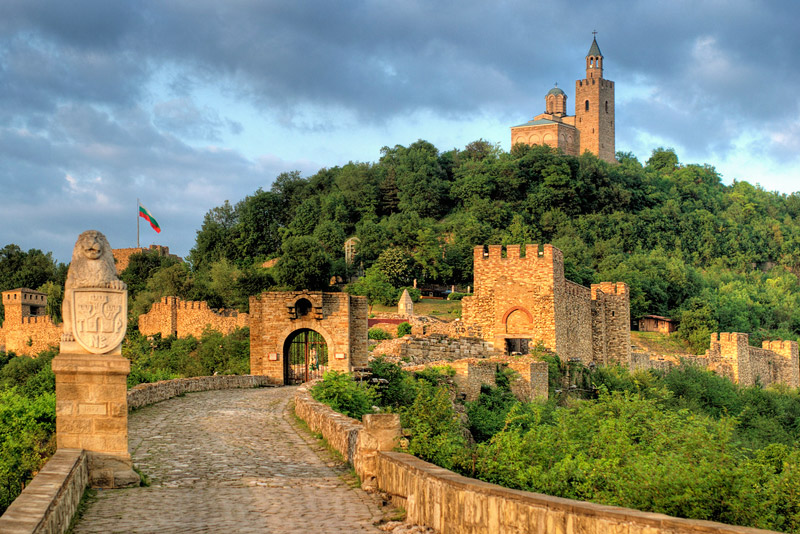
Fortaleza Tsaravets en Veliko Tarnovo (Bulgaria).
During the period of Ottoman rule (centuries 15 al 19) and in particular of the national renaissance (century 18 and 19), monastic communities take on a key role in public life in Bulgaria, since his spiritual efforts never ceased. Many monasteries were destroyed during the Ottoman invasion, but the others became important socio-political centers, educational and artistic fields of expression of the Bulgarian nation. Schools were established in monasteries in many places, the most educated people had studied there and later became teachers, clergymen, illustrated. During the national renaissance, a hundred large and small monasteries were rebuilt, in perfect combination with the surrounding nature.
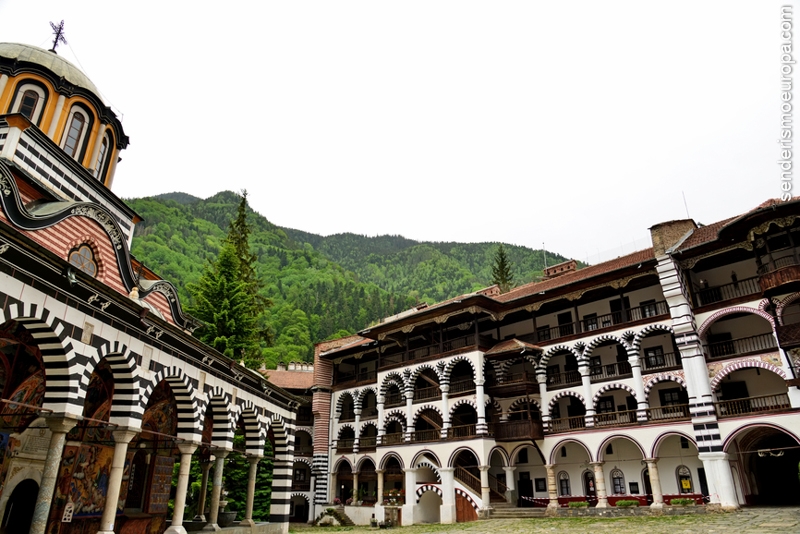
Patio of the Rila orthodox monastery
Monasteries like Preobrazhenski, Dragalevstsi, Báchkovo, Dryanovo, Troyan, Monasterio Arapovo, etc. treasured the sources of Bulgarian history, images of orthodox saints, commemorative inscriptions dedicated to the rulers of Bulgaria. They are repositories of historical information, of artistic and language traditions. Many of the learned monks like Paisyi Hylendarski, Sophronyi Vrachanski, Neophyte of Rila, Yosiph Bradati and others played a key role in the national revival.
Rock shrines such as the Aladzha and Ivanovo Monasteries epitomize the search for the conceptual link of making a reference to the Hesicasta religious movement that has occurred in the later years of the Byzantine period and in the second Bulgarian kingdom.. The hesychasts of those times believed that every mortal was condemned to death, but the spirit and the orthodox faith had to be saved and could survive. On the eve of the Ottoman occupation of the Balkan Peninsula, the Hesychast movement of the century 14 returned to the pure faith of the early Christians as a reaction to safeguarding the Orthodox identity of the Balkans.
Latest Articles

Bulgaria: Origin of the Goths and other ancient civilizations.
6 from October 2022
The Goths are considered as a people of Germanic origin but it is time to establish that the origin of the Goths is in the Balkans..

Why do Tourism in Bulgaria?
7 September, 2022
Thinking of sightseeing in Bulgaria? ️ What you should know: some peculiarities of the country that the travel guides do not tell you.

Rila monastery
17 Abil, 2022
Rila Monastery in Bulgaria: Location, his story, hiking trails in the surroundings, schedules and more.

What to see in Bulgaria in 12 days ?
12 from December 2021
The best travel route to visit Bulgaria in 12 days: the best cities, typical towns, monasteries, the Black Sea Coast.

Sandanski City.
17 of May 2021
How to get. Where to stay. To do. Places of interest. Hotels-spa. Swimming pools. Excursions to Pirin mountain. And more...

City of Veliko Tarnovo
27 of March 2021
Veliko Tarnovo, a fascinating city whose visit must be planned in advance. Read our proposal of where it is better to stay and how to get there by car

Viajes fly and drive , What should you know?
26 February 2021
Advantages and disadvantages of fly and drive or self-guided trips and details that nobody tells you but you should know before traveling

Bike tour organized by Bulgaria
16 February 2021
An entire MTB adventure for you and your friends on this organized bike trip with a local guide through the mountains of Bulgaria
Send a reply