
National Archaeological Museum of Bulgaria
Sofia's essential museum.
The National Archaeological Museum of Bulgaria (in bulgarian: National Archaeological Museum, National Archaeological Museum) is an archaeological museum located in the center of Sofia. For us it is “Sofia's must-see museum” because although there are others, This museum is very appropriate size for a quick visit and allows you to delve into Bulgarian History and Culture without spending a lot of time, apart from that its location is on the way in the classic tourist route of the center of Sofia. We know that people tend to visit Sofia very quickly and that it is not frequent to enter museums, but if you want to know something more about the country we visit and if you are curious about the origin of things, this museum is the ideal.
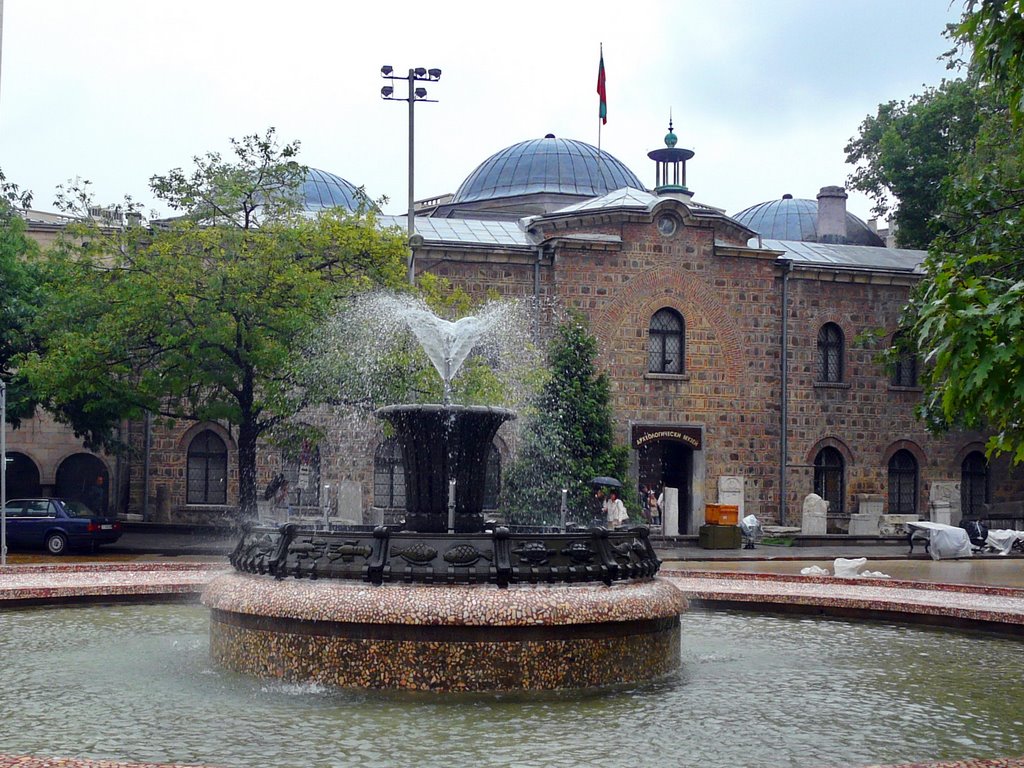
The museum occupies the building of a former Ottoman mosque in the center of the capital next to the presidency building, In fact, the square where it is located is a very frequented place since it is the place where people who want to see the changing of the guard of the Presidency of the Bulgarian Government congregate. The museum was founded in 1893 in the mosque and officially inaugurated in 1905, although the building was already occupied by the National Library since 1880.
Apart from the collections shown in the he, the building itself is worthy of admiration, It is the oldest building in the city from the time of the Ottoman occupation, The Great Mosque, o great mosque en turco, it was built around the year 1494 por Mehmed II Fatih. Outwardly it is a beautiful mosque, more like a Turkish bath building than a mosque. Inside the walls are painted in white but in the vaults there are areas that have lost their paint and you can see the original paintings of the mosque with beautiful floral motifs. In my opinion it is a shame that they were covered with white paint and it would be a wise decision to recover the original paint much more attractive than a simple layer of white paint, Art should not be a slave to politics or quarrels between countries…
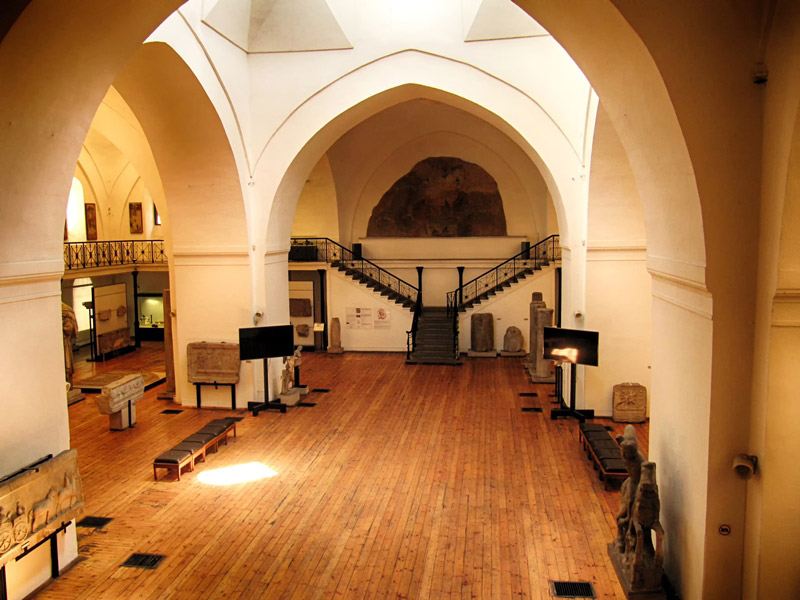
Main Hall of the Bulgarian National Archaeological Museum in Sofia.
The Bulgarian National Archaeological Museum in Sofia has five exhibition rooms, the main room, the top floor and 3 adjoining rooms:
The main room: In this room you can find funeral stelae, mosaics and Roman tombs mainly. Also elements of Greek and Byzantine influence. Highlights from Roman times (IV century d.C.) the “circus poster”, a representation in carved stone of the show of the Roman circus that was going to be performed in the city of Sofia, which at that time was called “Serdica”. The stone shows scenes from the show as if it were an advertisement, you can see beasts fighting each other (bottom left and right) or attacking people (top left) and fighters battling other animals like lions, Bears, snakes, etc.(central part).
In the same room there is a full-scale reproduction of the “Madara Knight”, a relief carved in stone from the 9th century that is located in the north of the country and is a UNESCO Heritage Site. There is also a mosaic from Roman times one of the best preserved that I have seen, maintains the color of the mosaics, the color is not blurred like most and is one of the most beautiful i have seen, displaying images of Paradise in full color.

“circus poster” romano
Attached room: Prehistory. It shows evidence of human activity on Bulgarian lands since 1,6 million years to year 1.600 a.C. and promotes the hypothesis that hominids came to Europe through the Balkan Peninsula from Africa, and not crossing the Strait of Gibraltar as was supposed in previous theories. Don't miss the ceramic piece with swastikas designs from the 6th millennium BC.. to refute those who, like Wikipedia, mention as the oldest swastika those found from the V millennium BC. in present-day Iran. Even more wrong are those who mention the Greek or Roman origin of swastikas…But that is another story… Photos are allowed, so make one of the oldest swastikas found, who are from Bulgaria, and of course they had nothing to do with the Nazis…

Part of a vessel from the VI Millennium BC. with swastika and sauastikas designs.
Top floor: Middle Ages: Medieval icons stand out, ceramics and tiles. Among them do not miss a rare icon made with tiles, which is very rare and also has the characteristic of having the oldest known inscription in Bulgarian in Cyrillic letters, 10th century (for those who still mistakenly think that the Cyrillic alphabet was invented in Russia, when it is of Bulgarian origin).
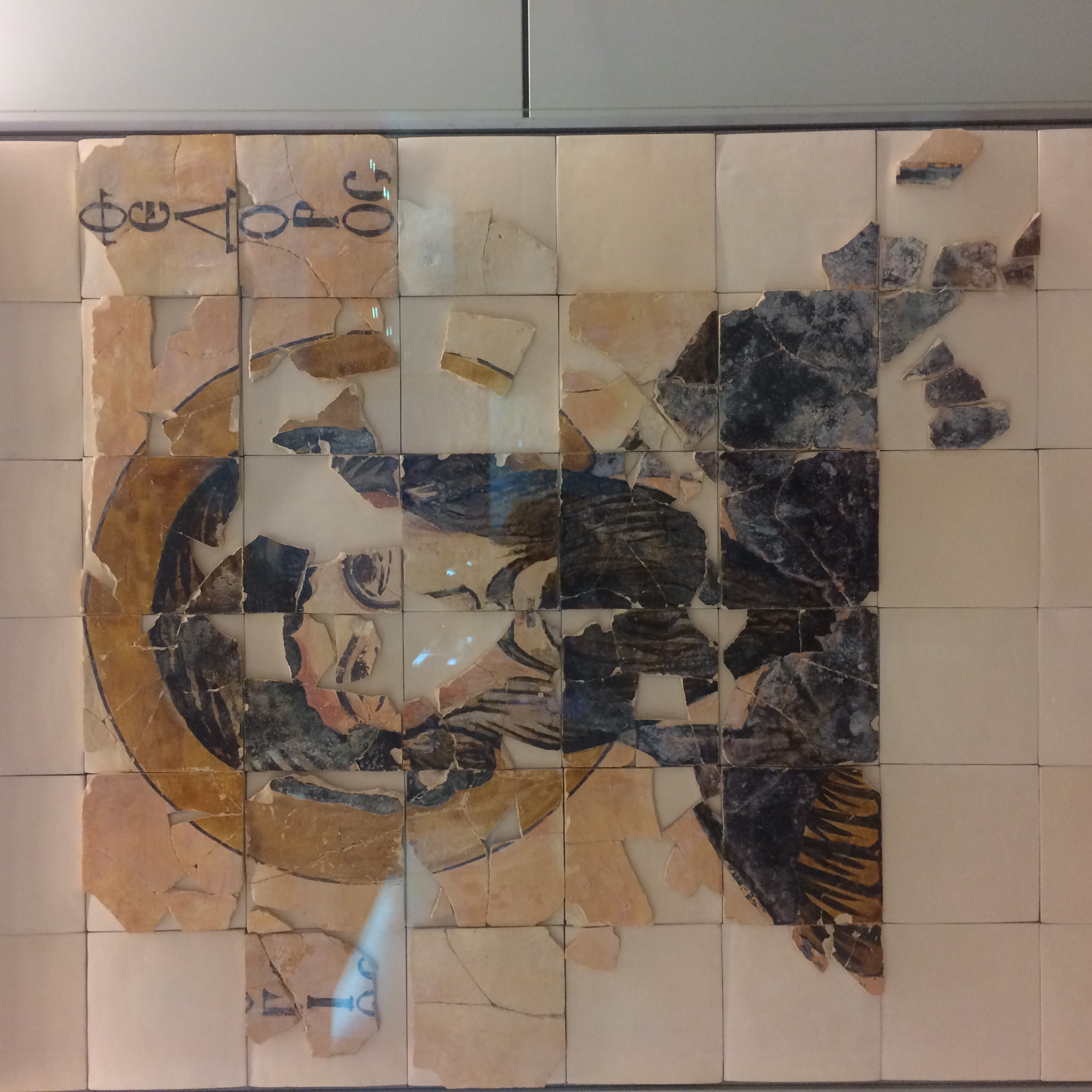
Tile icon from the 10th century BC. with inscription in Cyrillic letters
Attached room: treasure: A number of Thracian gold treasures stand out, the most famous are a solid gold funeral mask of a Thracian king and a delicate gold laurel wreath. The room is kept at a low temperature to preserve the treasures. Also on display are furnishings and ornaments from the Thracian civilization between the 8th and 3rd centuries BC.. Apart from the spectacularity of the gold treasures, it is worth mentioning the meticulousness and high professionalism of the craftsmen who made the Thracian pieces and which give an idea of how advanced the Thracian civilization was for its time., you just have to compare it with the pieces of the Roman or Greek times, that are from later centuries and draw your own conclusions…Greek and Roman civilization is often praised as the origin of Europe, but there are others that have been unjustly forgotten due to being unknown., how is the Thracian culture, in this Museum at least there are irrefutable proofs of its value waiting for one day history to finally award it the importance that it really deserves.

Solid gold Thracian funeral mask
Attached room: Temporary exhibitions. Consult the current exhibition on the official website of the Museum please.
Fact sheet of National Archaeological Museum of Bulgaria:
Official website of the museum: www.naim.bg
Museum address: Calle Saborna, 2, 1000 Sofia.
Sofia National Archaeological Museum fees:
Adults: 10 lv
Students: 2 lv
Free entrance: the last Sunday of every month
Guided tour by Museum staff:
• in Bulgarian: 10 lv
• in English: 20 lv
Opening hours:
From May to October: 10 am-6.00 pm (Open every day)
Last admission: 30 minutes before closing.
November to April: 10 am-5.00 pm (closed on Monday)
Last admission: 30 minutes before closing.
As usual is traveling with little free time, what I recommend is hiring the guided tour service and a museum employee will tell you the highlights of the Museum and historical details for the modest price of 20 lv (some 10,00 € to change), It is a small luxury that you can afford in Bulgaria because in the rest of Europe it would be much more expensive to have a museum guide at our exclusive disposal and who will make you feel like VIP people. However, among our tourist services we can include a local Spanish-speaking guide if you do not manage enough with English, too You can contact us for any other tourist service in Bulgaria.
Latest Articles

Bulgaria: Origin of the Goths and other ancient civilizations.
6 from October 2022
The Goths are considered as a people of Germanic origin but it is time to establish that the origin of the Goths is in the Balkans..

Why do Tourism in Bulgaria?
7 September, 2022
Thinking of sightseeing in Bulgaria? ️ What you should know: some peculiarities of the country that the travel guides do not tell you.

Rila monastery
17 Abil, 2022
Rila Monastery in Bulgaria: Location, his story, hiking trails in the surroundings, schedules and more.

What to see in Bulgaria in 12 days ?
12 from December 2021
The best travel route to visit Bulgaria in 12 days: the best cities, typical towns, monasteries, the Black Sea Coast.

Sandanski City.
17 of May 2021
How to get. Where to stay. To do. Places of interest. Hotels-spa. Swimming pools. Excursions to Pirin mountain. And more...

City of Veliko Tarnovo
27 of March 2021
Veliko Tarnovo, a fascinating city whose visit must be planned in advance. Read our proposal of where it is better to stay and how to get there by car

Viajes fly and drive , What should you know?
26 February 2021
Advantages and disadvantages of fly and drive or self-guided trips and details that nobody tells you but you should know before traveling

Bike tour organized by Bulgaria
16 February 2021
An entire MTB adventure for you and your friends on this organized bike trip with a local guide through the mountains of Bulgaria
Send a reply