
The truth about the origin of the myth of Achilles and the Trojan War
The truth about the Achilles myth.
Summary of contents of this page:
Napoleon Bonaparte once declared: “History is a collection of lies that everyone has accepted”. The divine origin of the Achilles myth and the epic Trojan War, Can be examples of it? … Next we go in search of the facts:
The Trojan War.
It is a well documented fact that sometime around the year 1200 a.C., the Aegean Sea area suffered a series of major natural and socio-economic catastrophes. These calamities included the physical destruction of cities, followed by migrations, severe depopulation and almost total cultural degradation. This was followed by the call “greek dark ages”, illiterate, which lasted in some areas for up to four centuries and ended around the 8th century B.C.. It was thereafter when the Greeks rediscovered writing, they invented a new alphabet and restarted trade with their eastern neighbors. Only then did the population increase dramatically and a rudimentary notion of political citizenship was forged.

The Achilles myth of the film “Troy” based on the mythological engravings of Greek pottery from the 6th to the 4th century BC. C.
Building on the Iliad and the Odyssey, in whose texts Homer (s. 8 a.C.) talks about the exploits of the Achilles myth in the Trojan War, the ancient Greek historians appropriated the figure of the hero Achilles to encourage the Greek population in difficult times, remembering this hero as an example of strength and bravery of the Greeks.
In those centuries of emergence of Greek culture from the s. 8 a.C., much later than the dates when Homer dates the Trojan War (between 1194 Y 1184 a.C.), we have an explanation for the drive to create or fabricate the Achilles myth and victory in the Trojan War: the pressing need to postulate a golden age “of yore” (that of the 12th century B.C.. prior to “Dark Age”), according to which “Greek” were able to muster an expeditionary force of more than 1.000 boats, led by heroic kings, and brave warriors like Achilles, in the case of Achilles leading the Myrmidons.

Massive landing on the shores of Troy, told by Homer and represented in the film “Troy” from 2004, of which however there have been no material remains…
The city of Troy certainly did exist, it's not a myth. The ruins of the city were found in Hisarlik (Today Northwest Turkey), in 1870, by Heinrich Schliemann, a wealthy Prussian businessman, passionate about archeology and eager to demonstrate that the places described in Homer's Iliad were historical and not invented, which he effectively achieved with his excavations. But it is about to demonstrate that the Trojan War really took place since no material remains nor archaeological events of such a magnitude in that area.
The Achilles myth in Homer's Iliad.
The Achilles myth of Homer's Iliad is distinguished by its extraordinary strength, courage and iron will. He does not hesitate to confront even the most glorious warriors of Troy, does not bow his head to the kings of the Achaeans. Proud, rebel, bad-tempered, is the son of Peleus and Thetis, as if he were an olympic god who acquired a human form. Perhaps Achilles' extraordinary character led ancient Greeks like Homer to create the legend that Achilles is the son of Thetis., a sea nymph, daughter of the god Nereo. So there was already an explanation for your son's special temperament and remarkable appearance, Achilles.
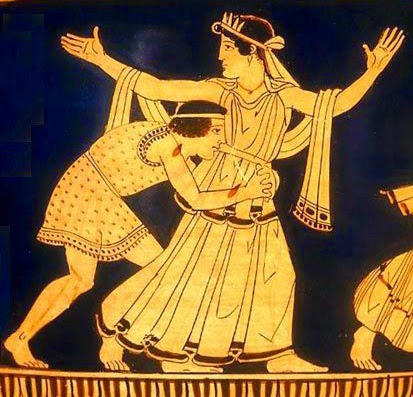
Fight (mortal) trying to capture his beloved Thetis (divine).
According to Greek mythology Thetis is one of the 50 sea nymphs, daughters of the god Nereo, known as the Nereids. Thetis was a nymph of great beauty whom the god Zeus wanted to marry the hero “Greek” Fight. Note that I often put the word in quotation marks “Greek” since it remains to be seen…
But apart from this mythological and almost divine version of the origin of Achilles that the Greeks contributed from the 8th century to. C., What are the facts that tell us about the true origin of Achilles?… Let's list them:
Investigations into the Thracian origin of Achilles.
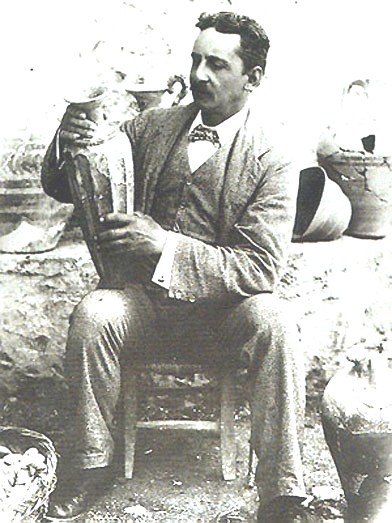
Archeologist Arthur Evans
At the end of the XIX century, most scholars were inclined to classify Achilles as of the Greek ethnic group. Fortunately, at the beginning of the 20th century, there were more progressive researchers who were not influenced by established beliefs and who strictly followed the facts. One of the first to conclude that the name Άχιλλεύς (Achilles in Greek letters) was not a name of Greek origin it was the prestigious British archaeologist Arthur Evans (1851-1941).
But if Achilles was not Greek, Where he was from?, What are your true ancestors?… The same view that Achilles was not Greek is shared by Flemish linguist Albert Joris Van Windekens (1915-1989). Declares that the name of Άχιλλεύς (Achilles) not a greek name, but a name pelasgo which is similar to the names of some rivers in the Thessaly region: Achelis , Αχελῶς . Swedish linguist Hjalmar Frisk (1900-1984) also talks about pre-greek origin ( pelasgo ) of the name Άχιλλεύς (Achilles) .
The Pelasgians are the predecessor peoples of the Hellenes as inhabitants of Greece and therefore prior to the arrival of the Greek language in the Aegean Sea. German author Bernhard Giseke published in 1858 your work about your studies, declaring that the language of the Pelasgians was the same as that of the Thracian (Bulgarian ancestors of today), they were the dominant civilization of the Balkan Peninsula in those days. Language “track-pelasgo”, as Bernhard Giseke called it, was spoken in ancient times not only before the invention of the Greek language, but also in the Neolithic ( VII millennium BC).
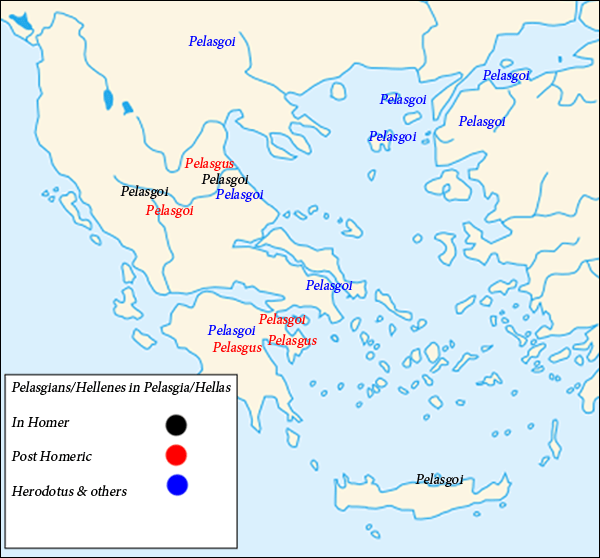
Location of the pelasgos according to Homero, Herodotus and others
At the end of the Bronze Age, the pelasgos, they remain in their native places, the territory from the Estruma river in present-day Bulgaria to the southern Peloponnese (southern Greece today). It is no coincidence that Pliny (famous roman writer and military man, 23 – 79 d.C.) affirm that the old name of the Peloponnese is Pelasgia (Source: Full . H . N . IV .9.). The father of Geography, Estrabón, also claims that the Peloponnese's previous name was Pelasgia . The same author is convinced that Thessaly was really called Argos Pelasgiano , and the tribes that inhabit the Epirus region are Pelasgos (Source: STRAB . V.2.4.). This information is in harmony with Herodotus himself, who lived before and who writes that the country called Greece was formerly known as Pelasgia (Source: Her . II .56).
In summary: during the Bronze Age, the Thracian-Pelasgians ruled the territory that today is called Greece . Strabo is extremely clear in stating that “in ancient times all of Greece was inhabited by barbarians”, that is to say, Thracian, since Thrace was land “Barbarian” from the partial Greek point of view… Strabo even gives precise data that explains that all of Attica was ruled by the Thracians, and in the city of Delphi the Thracian king Tereo reigned. He also mentions that the Peloponnese is inhabited by Phrygians (town also related to the Thracian-Pelasgians), whose king, Pelops (Pelope, meaningful name in Thracian language but not in Greek) is the one who gives the peninsula its name… Even Greek authors also name Agamemnon as the grandson of Pelops., therefore Agamemnon, king of Mycenae and leader of the Achaean armies against the Trojans had Phrygian ancestors, not Greek origin.

Greek pottery depicting a Thracian-Pelasgian
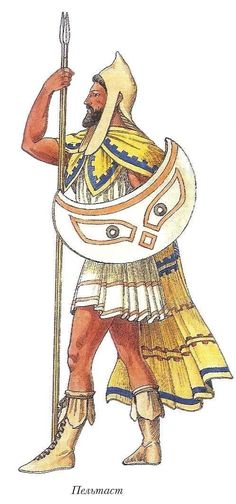
Reproduction of Thracian-pelagic clothing
Thanks to the fact that the Phrygians (let's remember: descendants of the Thracians) ruled the Bosphorus Strait, and the Dardanelles, They managed to gain enormous wealth. It was these riches that caused the outbreak of the Trojan War, if this was actually produced… A war between relatives: Thracian-Pelagian who ruled the lands of present-day Greece against the Phrygians (also thracians) who dominated the West of present-day Turkey. It is not the first time in history that a war has occurred between populations of the same ethnicity and culture., nor would it be the last…. So this war, if it occurred, It was not for the flight of the beautiful Helena next to the Trojan Paris, if not because of the commercial competition between the Thracians of the East and West coast of the Aegean Sea… Of course for Homer, who was more poet than historian, and for the many followers of Greek mythology, is much more “poetic and romantic” seek as a cause of the Trojan War the love between Helena and Paris that the simple fact of fighting for commercial power in the region…
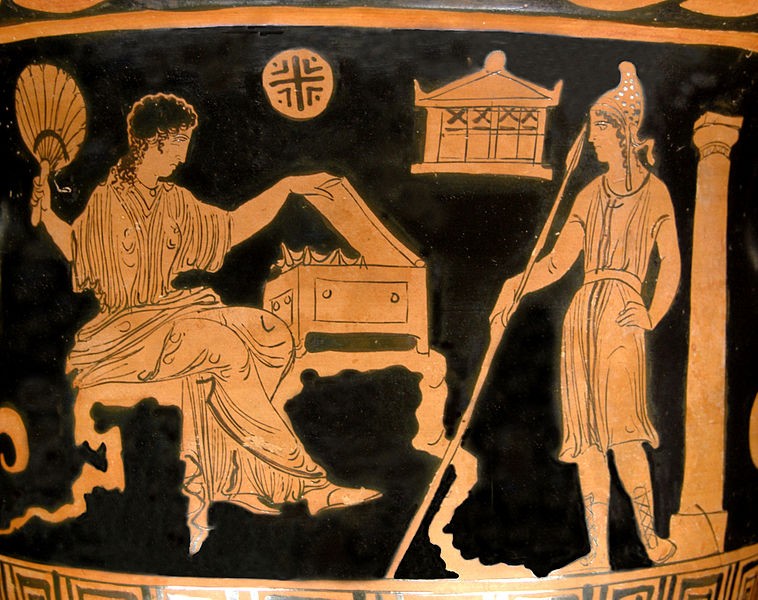
Helen of Troy and Prince Paris (note Paris with the typical Thracian-Phrygian hat)
Even after this 12th century BC conflict. (be it military or just commercial) and until the 8th century B.C., the Thracians continued to own the seas and the lands surrounding the Aegean Sea. The authentic Greeks, came from North Africa in the 2nd millennium B.C., and they were under the Thracian government all those centuries (it's the dark ages mentioned above and purposely forgotten by ancient greek historians). For centuries the Greeks have been unable to overcome the strong cultural and military current that comes from the Black Sea.. Only after the fall of the Phrygian Kingdom under the blows of Assyria in present-day Turkey, it was when the true Greeks learned to build ships good enough to begin colonizing the Aegean Sea and the lands around it.
The pelasgo origin (tracking) Achilles explains many things. And not only the name of the ancient hero has no meaning in Greek. The same goes for his mother's name Θέτις / Aunt . Professor Hjalmar Frisk was again clear and concise: ” The identification of Thetis as a Pelasgian character is necessary” (” The detour via the Pelasgian seems hardly necessary ” ).

Orpheus charming the animals with music (notice again, wearing the typical Thracian hat).
Of course, the name of Πηλεύς / Peleus / Fight, Achilles' father, nor is it greek. The suffix – εύς in the Greek language is an indication of the foreign origin of the word. And we have other examples with this suffix: It is more than clear that Oρφευς / Orfeo, not a greek name, sino tracking, as the Russian linguist Yuri Otkupshchikov (1924-2010) pointed out some time ago. We also mentioned before that Strabo spoke of the Thracian king Tereo as ruler of the city of Delphi.. As well, tereo, oh Tereus, is written in greek:Fish , again with the suffix -εύς (that is to say, it's a foreign name, not greek).
Definitive proof of the Thracian origin of Achilles.
But not only the discipline of the toponymy and the studies of the authors mentioned above support the fact that Achilles was not Greek but Thracian-Pelasgian. There is other evidence of the Pelasgian origin of Achilles. During late antiquity, but especially in the early Middle Ages, many things related to the origin of the characters of the Iliad were hidden. But nevertheless, the truth cannot be destroyed. The ancient images of Achilles remain and are quite different from traditional. The images that have been preserved from the myth of Achilles on Greek frescoes or ceramics are idealized by the ancient Greeks because they were drawn many centuries after these events occurred..
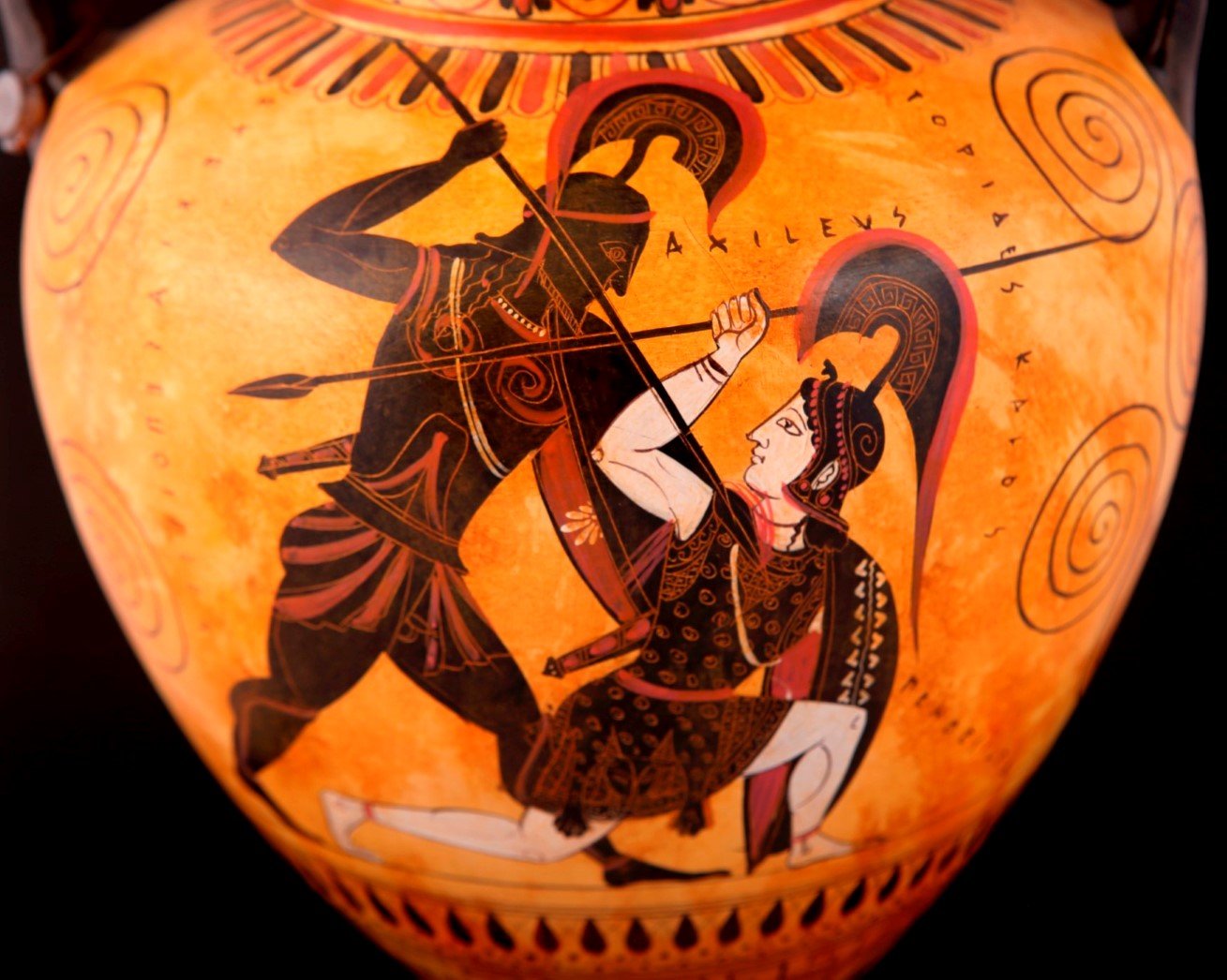
The myth of Achilles in Greek pottery of the s. VI a.C.
However at the beginning of the 20th century, in 1908, Several volumes of books were published in Germany on the culture of the ancient Hellenic civilization: “The Hellenic culture” with ancient drawings of Achilles surprising and mysteriously forgotten… Los autores Fritz Baumgarten, Franz Poland and Richard Anton Wagner publish in them beautiful but little-known images of statues, fresh, etc. from the time when the Trojan War allegedly took place. Among the unique drawings are also those of Achilles. One of them is of special importance for History because the young hero is represented with his head shaved from behind leaving a lock of long hair above, that is to say, a quiqui.
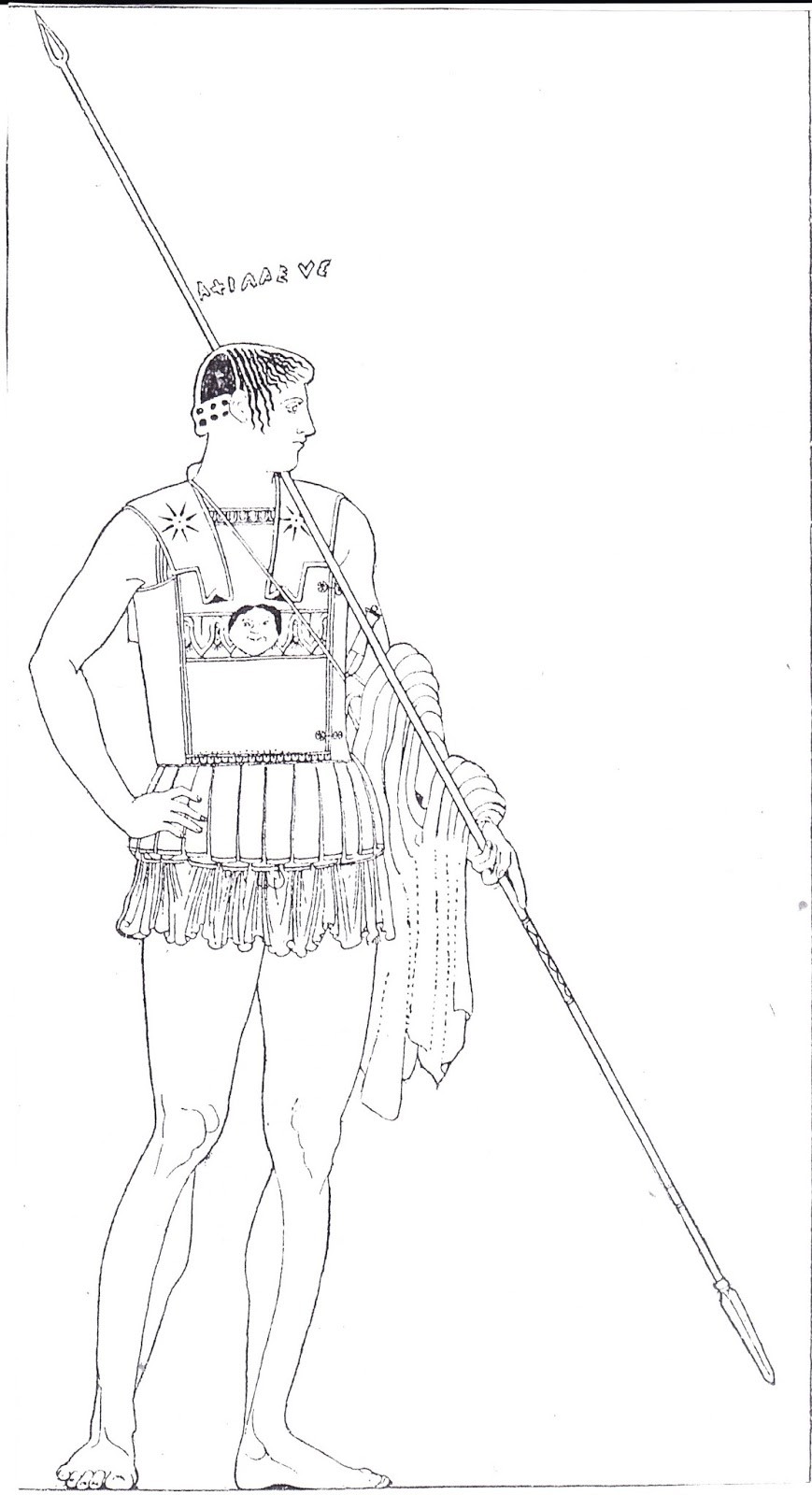
Drawing of the young Achilles contributed by the 3 authors of “The Hellenic culture”.

Shaving his head and leaving a lock was not a typical Greek custom , but something practiced by the Thracians and Pelasgians belonging to their community. Plutarch tells us about Theseus' special hairstyle (which is not a Greek name either: Theseus sino tracio-pelasgo) and explains why the Thracian tribes of Abantes and Mizis shave off part of their hair and let another part grow freely (source: Rather. He .5.1), which the Greeks did not do. According to Plutarco, shave your head from behind, leaving only a lock at the top, It has the mission that in the hand-to-hand fight the enemies cannot hold them by the hair attacking from the back, thus avoiding a weak point.
 The founder of Athens according to Greek mythology, Teseo, has been considered Greek for a long time, but those who read Plutarch are aware of the Thracian-Pelasgian origins of Theseus. The old author explains that Theseus' maternal line came from the Phrygian Pelops family, while his paternal line belonged to Erechtheus and the country's indigenous population: the Pelasgos or the firstborn of the earth, as Plutarch calls them (source: Rather. He .3.1).
Phrygian warrior head found in lands of Asia Minor showing shaved head with hardly a quiqui. Source: https://www.veda.harekrsna.cz/connections/img/god-sikha.jpg
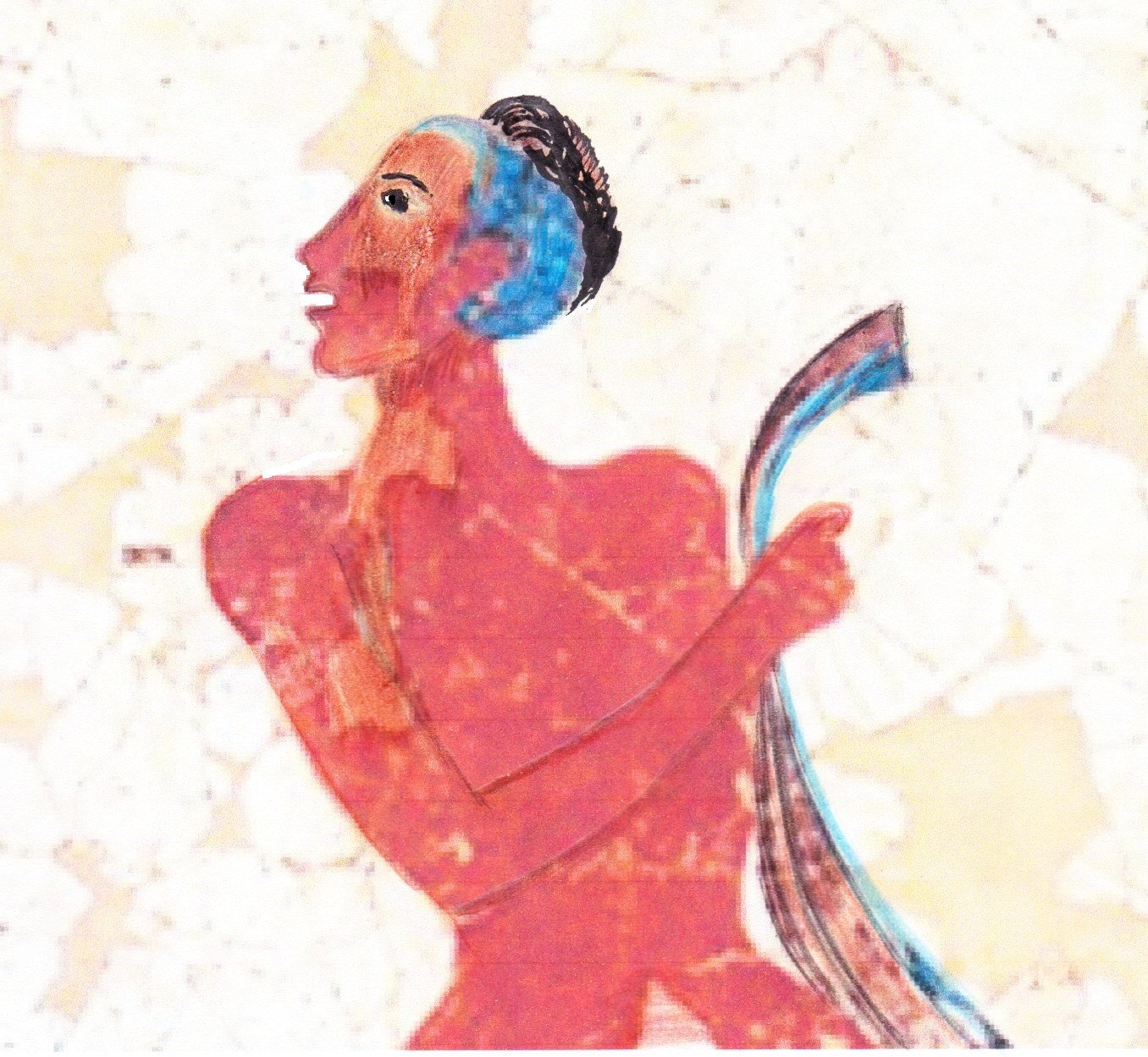
By Homer and Strabo, We know that Minoan Crete was inhabited by Thracian-Pelasgians, who are even called gods for their superior culture and wisdom. Thanks to the surviving frescoes of the Bronze Age, we know what the pelasgos were physically like. Certain individuals are represented with a shaved head and one or more quiqui. Therefore, in addition to Plutarco's written testimony, we also have material evidence that the Thracian-Pelasgians, or more precisely certain groups of them, they shaved their heads and wore quiquis, Just like Achilles!!.
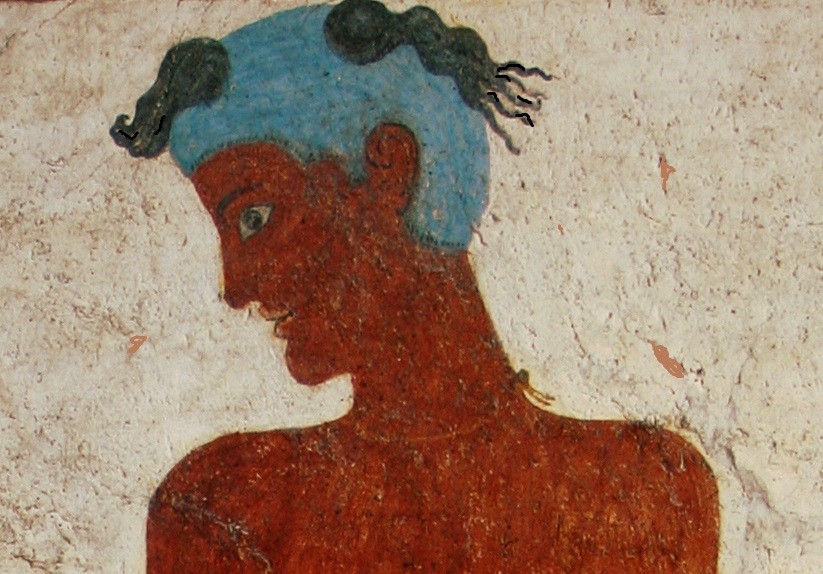
Santorini Minoan frescoes depicting Pelagian warriors with shaved heads and quiquis. R's Photos. van Zandt.
Conclusions.
The survival of the drawing representing Achilles with a quiqui is really a miracle. The enemies of this uncomfortable truth were aware of facts that were quite inconvenient to them, since the beginning of the 20th century. They knew about the Thracian-Pelasgian origin of Theseus, Fight, Thetis and Achilles, as well as the fact that the Thracian-Pelasgians wore a quiqui. At the same time, they saw how the bulgarians, even until the Middle Ages, they had retained the custom of their Thracian ancestors to wear quiqui and the rest of their shaved hair. This caused panic among followers of the lies of classical Hellenic culture..
Any evidence linking the roots of classical Hellenic culture with the northern regions of Greece (current Bulgaria, Macedonia, Albania…) has had to be destroyed by the enemies of “the truth”, and in fact many things have been erased. We are talking about inconvenient chronicles, as well as statues, epigraphic monuments, etc. destroyed once the Greeks had supremacy over the Aegean Sea from the 8th century B.C.. The Ottoman occupation of almost 5 centuries between the end of the XIV century and the end of the XIX of the Bulgarian lands also produced great destruction of the ancient Thracian remains. The 2 contemporary world wars and the subsequent communist era until 1990 have kept Bulgaria silenced for centuries, but now some scholars raise their voices and claim the importance of Thracian culture and civilization in the development of Europe, like the first civilization, prior to Greek and Roman…
Some countries have built a prestigious and tourism industry, appropriating achievements, deities and heroes of the ancestors of the Bulgarians. Lobbyists in these countries will zealously continue to defend the status quo, because if it is raped, the consequences would be serious for them, both in terms of finances and image… We end how we start, with a phrase that makes you think, enunciated by the American writer, Pulitzer Prize winner, Upton Sinclair (1978-1968) what did he say: ” It's hard to get a man to understand something, when your salary depends on you not understanding it “…
Please leave your comment or opinion below, in section “Send a reply”. Commenting on the Achilles myth is free, cheer up…
Author of the article: Luis Car.
Article Source: the linguist and historian Pavel Serafimov.
Bibliographic references:
1. Greek sources for Bulgarian History, volumen II , edited by Iv. Duychev, G. Tsankova-Petkova, V. Tapkova-Zaimova, L. Yonchev, P. Tivchev, ed. Alabama. Burmov, Bulgarian Institute of History , LOW, Sofia, 1958;
2.St. Mihailov, Towards the interpretation of the complex sign IYI and the expression Mednoto Gumno, Notices of the National Museum in Varna 23 (28), Georgi Bakalov Publishing House, Varna, 1987;
3.Yu.V. Kotkupschikov, Dogrechesky substrate at the origins of European civilization, Ed. Leningrad University, Leningrad, 1988;
4 . Estrabón, Geography, transl. HL Jones, ed. GP Goold, books 6-7, THE LOEB CLASSIC LIBRARY, Harward University Press, London, 1995;
5 . W. Smith. A dictionary of Greek and Roman biography and mythology. John Murray: impreso por Spottiswoode and Co., New-Street Square y Parliament Street, London, 1873;
6 . A. Evans, SCRIPTA MINOA II, The written documents of Minoan Cretan with special reference to the Knossos archive, vol. II, Oxford, Clarendon Press, 1952 , p. 67 ;
7.AJ Van Windekens, Pelasgique, Essay on a prehellenic Indo-European language, University publications, Louvain, 1952;
8.H.Fisk, etymological Greek Woerterbuch. Heidelberg, 1960;
9. Hellenistic culture by F. Baumgarten, F. Poland, R. Wagner, Second assembly, BG Teubner publishing house, Leipzig and Berlin, 1908;
10. Plutarch, Parallel life, Theseus' life, publ. And full. I de la Loeeb Classical Library Edition, 1914.
Latest articles

14 Fun facts about Bulgaria
12 of June 2020
We share some curiosities and information about Bulgaria and aspects that you have never heard of..

Recommended trip to Bulgaria
6 of June 2020
Recommended trip to Bulgaria that includes some of the best places to visit. Combine cultural tourism and moderate hiking.

Achilles and the Trojan War: the truth about the origin of a myth.
20 Mayo, 2020
Apart from the mythological and almost divine version of the origin of Achilles that the Greeks contributed from the 8th century to. C., What are the facts that tell us about the true origin of Achilles?...

Pirin National Park
2 Mayo, 2020
The highest mountain in the entire Balkan Peninsula, admired and feared, a jewel of biodiversity that remains unspoiled on this side of Europe.

Sofia, unusual and secret
19 of March 2020
We are going to visit the city of Sofia and its surroundings knowing unusual places, secrets, or that do not appear in the usual tourist guides

Benefits of thermal waters , What is the best for your health?
13 of March 2020
The amount and type of water you need to drink to get benefits of the hot springs is a strictly personal matter. It depends on the overall body, water mineralization, physical and mental condition of each individual.
Send a reply